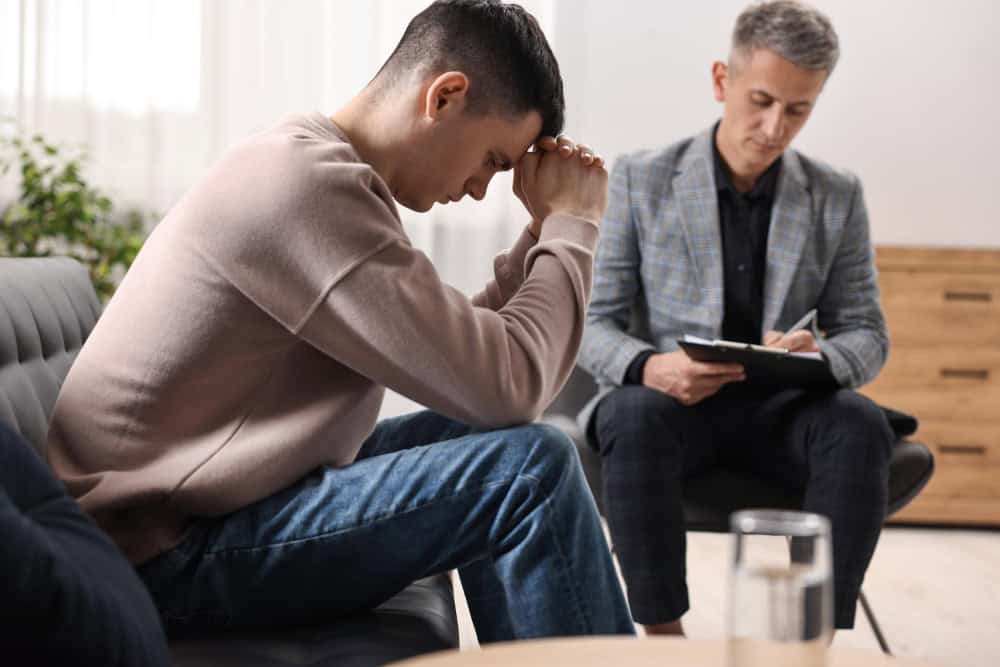


Trauma costs you sleep, patience, trust, and focus at work. It can make a silent evening feel unsafe, and a small disagreement feel like a threat. Living on high alert wears you down. Asking for help can feel like one more thing to manage. Purple Recovery Center for Men offers trauma and PTSD treatment in Lawrenceville, GA. You can come to us for this care without a substance use concern. You work with licensed therapists and build skills for sleep, anger, and trust. Family members who search first are welcome to call too.

What Trauma Does to Your Mind and Body
Trauma is an event, or a long stretch of events, that overwhelms your ability to cope. Combat, an assault, a car wreck, or years in an unsafe home can all qualify. Your mind and body respond. Your heart races, your muscles tense, and your sleep breaks apart. These reactions often ease over time.
Trauma is what happened to you. PTSD is a diagnosable condition that can follow when those reactions do not ease. According to NIMH’s PTSD overview, a diagnosis requires symptoms that last longer than one month and disturb daily life. Not every man who lives through a dangerous event develops PTSD, and having it says nothing about your strength.
Four Patterns That Point to PTSD
PTSD looks different in every man, but the symptoms tend to fall into four groups. See which ones sound familiar.
- Reliving it: flashbacks that feel like the moment is happening again, nightmares, and memories that hit without warning.
- Avoiding reminders: steering clear of places, events, or objects tied to what happened.
- Staying on edge: hypervigilance, which means scanning every room and never fully relaxing. You may also startle easily, sleep poorly, snap at people, or take risks.
- Feeling different: guilt, self-blame, numbness, and pulling away from people or things you used to enjoy.
You may not describe this in clinical terms. You might call it a short temper, bad sleep, or a need to be alone. Some men start drinking at night to fall asleep. These are common responses to what you have been through, and treatment can help.
Not All Trauma Looks the Same
Your history may fit one type or several. What separates them is how often the harm happened and when it started.
Acute Trauma From a Single Event
Acute trauma follows one recent event, such as a crash, an attack, or a sudden death. The reaction starts close to the event. For many men, it fades with time and support. For others, it settles in and becomes PTSD.
Chronic and Complex Trauma From Repeated Exposure
Years of combat, violence at home, or constant danger on the job add up to chronic trauma. Your body never gets a chance to stand down. Clinicians use the terms complex trauma and complex PTSD for these long-lasting effects.
Childhood Trauma That Carries Into Adulthood
Abuse, neglect, or a home where violence was normal shapes a boy long before he can name it. It counts as trauma even if no one ever called it that. As an adult, you could struggle with trust, anger, or closeness and never connect it to those years.
How We Treat Trauma at Purple
At Purple Recovery Center for Men, our approach to trauma and PTSD treatment in Lawrenceville, GA starts with trauma-informed care. That means we pay attention to how a hard history changes your stress response and your ability to trust.
Here, you work through what happened, how it still affects your days, and what you want to change. Through Foundations for Living, our life skills program, you also build self-care and emotional regulation skills. Those give you something to use when anger or panic spikes.
Individual Sessions With a Licensed Therapist
Personalized Care means one-on-one sessions with a licensed therapist, typically weekly. Your therapist starts with your history and your goals. Together you practice coping skills. Grounding brings you back to the present during a flashback, and emotional management helps you settle intense anger or panic.
Family Recovery for the People Closest to You
Our Family Program gives the people closest to you a role in your care. They meet with a family coordinator every two weeks and attend monthly Saturday workshops. Online educational materials help your family understand what you are working on.
Three Ways to Do This Work Around Your Life
You can get trauma and PTSD treatment in Lawrenceville, GA at three levels of care. Each one fits a different stage and schedule. Partial hospitalization (PHP) is our most structured level. It runs Monday through Friday, 9 a.m. to 2 p.m., with your peers in the program.
Intensive outpatient (IOP) has a daytime track from 9 a.m. to noon and an evening track that starts around 6 p.m. Both run 5 days a week. You attend 3 to 5 sessions weekly based on what you need.
Outpatient (OP) is the least intensive level, with minimal schedule demands so you can keep working.
At Purple, most men benefit most from our 90-day program, though our programs run anywhere from 30 days to 6 months. We begin with an assessment and placement review, so you start at the level that fits.
How Do You Know It Is Time to Get Help?
The signs look like stress or a busy season, so it’s easy to explain them away. You take the long way home to avoid one road. You skip the family cookout because the noise is too much. You say “I’m fine” so often that the words stop meaning anything. You tell the story of that day in a flat voice, as if it happened to someone else.
Time is the other signal. It’s time to seek professional help if your symptoms do not improve over time or interfere with daily life. If a partner or a friend says you seem different, that counts as information too.
Treat it as a physical injury. A shoulder that still hurts months later gets looked at. A mind that keeps re-experiencing the worst day of your life deserves the same attention.
When Alcohol or Drugs Become Your Way of Coping
Alcohol or drugs can become the way you get through the nights, the memories, or the anger. They may take the edge off for a while. Over time, they can worsen sleep and mood. That pattern is a way of coping, and it needs its own support alongside the trauma work. Dual diagnosis care treats an addiction and a mental health condition at the same time. We provide it at our Lawrenceville campus, so your trauma and your substance use get care together.
If you need detox first, we arrange it through a partner facility before you begin PTSD treatment in Georgia with us. We keep in touch during detox. Before it ends, we prepare a plan for supportive housing, PHP, or IOP.